Ventilator Settings and Waveforms
Ventilator settings are written in a compressed shorthand, AC/VC 450/18/5/40%, that packs the mode and four numbers into one line. This page explains each setting, how the common modes differ, which pressures to watch, the lung-protective targets behind most starting settings, and how to read the three waveforms on the screen.
Last reviewed October 8, 2026 against the 2024 American Thoracic Society guideline update on ARDS. A study and documentation reference, not a management protocol.
On this page: the settings · modes · pressures · lung-protective targets · waveforms · in a note
The settings in a vent order
| Setting | Written as | What it controls |
|---|---|---|
| Mode | AC/VC, AC/PC, PRVC, PSV, SIMV, CPAP | how breaths are triggered, delivered, and ended |
| Tidal volume | Vt 450, or 6 mL/kg PBW | volume of each breath, set per kilogram of predicted body weight |
| Rate | RR 18, f 18 | minimum mandatory breaths per minute; the patient can breathe above it |
| PEEP | PEEP 5, +5 | pressure held in the airways at the end of exhalation, in cmH2O |
| Inspired oxygen | FiO2 40% | fraction of inspired oxygen, from 21% (room air) to 100% |
| Inspiratory pressure | Pinsp 15, PC 15 above PEEP | in pressure control, the pressure applied during inspiration |
| Pressure support | PS 10/5 | pressure added to each spontaneous breath, written over the PEEP |
| Timing | Ti 1.0 s, I:E 1:2, flow 60 L/min | inspiratory time, inspiratory to expiratory ratio, and inspiratory flow |
Common modes
| Mode | Clinician sets | Varies with the lungs |
|---|---|---|
| Assist control, volume control (AC/VC) | tidal volume, rate, flow, PEEP, FiO2 | airway pressure |
| Assist control, pressure control (AC/PC) | inspiratory pressure, inspiratory time, rate, PEEP, FiO2 | tidal volume |
| Pressure-regulated volume control (PRVC) | target tidal volume; the ventilator adjusts pressure breath by breath | pressure, within limits |
| Pressure support (PSV) and CPAP | support pressure and PEEP; the patient sets rate and timing | tidal volume and rate |
| Synchronized intermittent mandatory ventilation (SIMV) | a set number of full breaths; extra breaths are the patient's own, often with pressure support | volume of the extra breaths |
The pressures to watch
Peak pressure is the highest airway pressure in the breath. Plateau pressure is read during a brief inspiratory hold, when flow stops and only the stiffness of the lungs and chest wall remains. Driving pressure is plateau minus PEEP, the pressure that actually stretches the lung. Static compliance is tidal volume divided by driving pressure. An expiratory hold measures auto-PEEP, pressure left behind when exhalation is incomplete.
The gap between peak and plateau localizes a problem. A high peak with a normal plateau means resistance in the airways or tube: secretions, bronchospasm, a kinked or bitten tube. A high peak and a high plateau mean stiff lungs or chest wall: ARDS, pulmonary edema, pneumothorax, a mainstem intubation, or abdominal distension.
Lung-protective targets
The 2024 ATS guideline update kept the strong recommendations of the 2017 guideline: limit tidal volume to 4 to 8 mL/kg of predicted body weight and plateau pressure to below 30 cmH2O in ARDS, and use prone positioning for more than 12 hours a day in severe ARDS. It added conditional recommendations for higher PEEP without recruitment maneuvers in moderate to severe ARDS, corticosteroids, neuromuscular blockade in early severe ARDS, and VV-ECMO in selected severe cases, and a strong recommendation against prolonged recruitment maneuvers. Many ICUs apply the same tidal volume limits to every intubated patient.
| Target | Usual starting point |
|---|---|
| Tidal volume | 6 mL/kg predicted body weight (ARDS Network), within 4 to 8 |
| Predicted body weight | men 50 + 2.3 × (inches − 60) kg; women 45.5 + 2.3 × (inches − 60) kg |
| Plateau pressure | below 30 cmH2O |
| Driving pressure | as low as practical, often about 15 cmH2O or less (an observational target) |
| Oxygenation | SpO2 88 to 95% or PaO2 55 to 80 mmHg (ARDS Network) |
| Rate | adjusted to pH, up to 35 breaths a minute in the ARDS Network protocol |
Worked example: a man who is 70 inches tall has a predicted body weight of 50 + 2.3 × 10 = 73 kg, so 6 mL/kg is about 440 mL, whatever he actually weighs.
Reading the waveforms
Most ventilators draw three curves against time: airway pressure, flow, and volume. Flow above the line is inspiration and below it is expiration. The shape of the curve tells you the mode: in volume control the flow is square and pressure rises to a peak; in pressure control the pressure is square and flow decelerates.
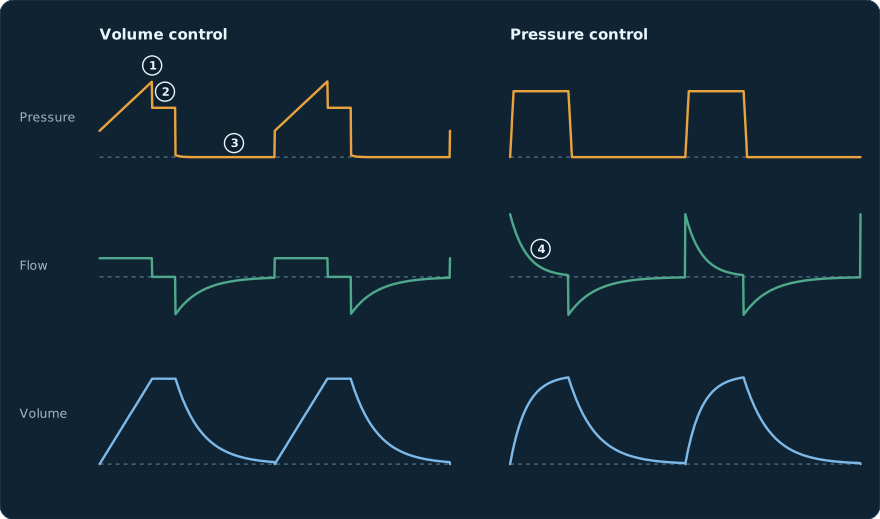
- Peak inspiratory pressure, at the end of the square flow.
- Plateau pressure, during the inspiratory pause when flow is zero.
- PEEP, the pressure held between breaths.
- Decelerating flow, the signature of pressure control.
Auto-PEEP shows up on the flow curve as expiratory flow that never returns to zero before the next breath starts. Gas is being trapped, which raises intrathoracic pressure and can drop blood pressure. It is classic in COPD and asthma and at high rates, and the usual fixes are a lower rate, a shorter inspiratory time to lengthen exhalation, and treating bronchospasm.
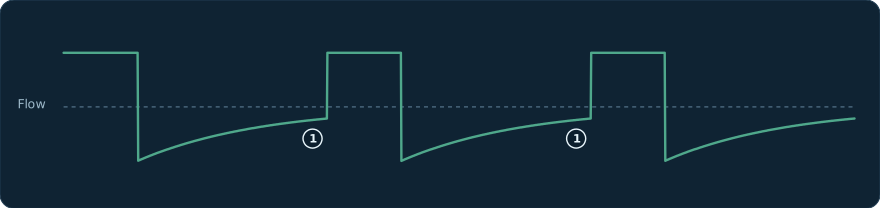
- Expiratory flow has not returned to zero when the next breath starts: auto-PEEP.
How it reads in a note
| As written | Read as |
|---|---|
| Vent: AC/VC 440/18/+8/40%, Pplat 24, DP 16 | volume control, 440 mL breaths, rate 18, PEEP 8, FiO2 40%; plateau 24, driving pressure 16 |
| ABG 7.31/48/78 on above | pH 7.31, PaCO2 48 mmHg, PaO2 78 mmHg on these settings |
| SBT on PS 5/5 x 30 min, RSBI 62 | spontaneous breathing trial on pressure support 5 over PEEP 5 for 30 minutes; rapid shallow breathing index 62 |
| ETT 7.5 @ 23 cm at the lip | endotracheal tube, 7.5 mm internal diameter, 23 cm at the lip |
Practice typing it
Vent lines mix slashes, percent signs, and plus signs with numbers, which slows most typists down. The ICU and pulmonary packs bring this shorthand into the stream.
ICU notes and vent settings Pulmonary and critical care
Preset links open the trainer with those settings already applied; you can change them afterward.
See also the arterial line waveform and central venous pressure waveform guides, and ICU typing practice.
Common questions
What does AC/VC 450/18/5/40% mean?
Assist-control volume control, a tidal volume of 450 mL, a set rate of 18 breaths a minute, PEEP of 5 cmH2O, and 40 percent inspired oxygen. Every breath, whether the ventilator or the patient starts it, delivers the full set volume.
What is PEEP?
Positive end-expiratory pressure: the pressure the ventilator keeps in the airways at the end of each exhalation, usually 5 cmH2O or more, to keep alveoli from collapsing and improve oxygenation.
What is the difference between peak and plateau pressure?
Peak pressure is the highest airway pressure during the breath and includes the pressure needed to push gas through the airways. Plateau pressure is measured during a brief inspiratory hold with no flow, so it reflects the stiffness of the lungs and chest wall. A high peak with a normal plateau points to the airways; both high points to the lungs.
What is driving pressure?
Plateau pressure minus PEEP: the pressure that actually stretches the lung with each breath. In observational analyses lower driving pressure was linked with survival in ARDS, and many clinicians aim for about 15 cmH2O or less, but it has not been tested as a randomized target.
How do you calculate predicted body weight?
The ARDS Network formulas use height: 50 + 2.3 × (height in inches minus 60) kg for men, and 45.5 + 2.3 × (height in inches minus 60) kg for women. Tidal volume is set per kilogram of this predicted weight, not actual weight.
Sources
- Qadir N, Sahetya S, Munshi L, et al. An Update on Management of Adult Patients with Acute Respiratory Distress Syndrome: An Official American Thoracic Society Clinical Practice Guideline. Am J Respir Crit Care Med. 2024;209(1):24-36.
- Acute Respiratory Distress Syndrome Network. Ventilation with lower tidal volumes as compared with traditional tidal volumes for acute lung injury and the acute respiratory distress syndrome. N Engl J Med. 2000;342(18):1301-1308.
- Amato MBP, Meade MO, Slutsky AS, et al. Driving pressure and survival in the acute respiratory distress syndrome. N Engl J Med. 2015;372(8):747-755.
Waveforms on this page are schematic drawings made for it, not patient recordings.