Lab Abbreviations and Fishbone Diagrams
Lab results fill every progress note, and almost all of them are abbreviated: a BMP, a CBC with diff, LFTs, coags, an ABG. This page lists what each panel contains, shows the fishbone diagrams clinicians use to write labs compactly, and shows how those diagrams are typed when a note cannot draw them.
Last reviewed October 8, 2026. Reference ranges differ between laboratories, so this page explains what the tests are, not their normal values.
On this page: what each panel contains · fishbone diagrams · typing labs in a note
What each panel contains
| Abbreviation | Stands for | Contains |
|---|---|---|
| BMP, Chem 7 | basic metabolic panel | sodium (Na), potassium (K), chloride (Cl), bicarbonate (HCO3, often reported as CO2), blood urea nitrogen (BUN), creatinine (Cr), glucose, and calcium; Chem 7 is the same list without calcium |
| CMP, Chem 14 | comprehensive metabolic panel | the BMP plus albumin, total protein, alkaline phosphatase (ALP), alanine aminotransferase (ALT), aspartate aminotransferase (AST), and total bilirubin |
| CBC, CBC with diff | complete blood count, with differential | white blood cells (WBC), hemoglobin (Hgb), hematocrit (Hct), platelets (Plt), and red cell indices such as MCV and RDW; the differential adds each white cell type |
| LFTs, hepatic panel | liver function tests | AST, ALT, ALP, total and direct bilirubin, albumin, and total protein; notes often add GGT and the INR |
| coags | coagulation studies | prothrombin time (PT), the INR (international normalized ratio), and partial thromboplastin time (PTT or aPTT); fibrinogen in some panels |
| ABG, VBG | arterial or venous blood gas | pH, partial pressures of carbon dioxide and oxygen (PaCO2, PaO2), bicarbonate, and base excess; many analyzers add lactate and electrolytes |
| Mg, Phos, iCa | magnesium, phosphorus, ionized calcium | often drawn with the morning BMP |
| UA | urinalysis | specific gravity, pH, protein, glucose, ketones, blood, leukocyte esterase, nitrite, and microscopy |
| A1c, TSH, fT4 | hemoglobin A1c; thyroid-stimulating hormone; free thyroxine | average glucose over about three months; thyroid screening |
| trop, BNP | troponin (often high-sensitivity, hs-cTn); B-type natriuretic peptide or NT-proBNP | heart muscle injury; heart failure |
| lactate, procal, CRP, ESR | lactic acid; procalcitonin; C-reactive protein; erythrocyte sedimentation rate | perfusion and infection or inflammation markers |
Fishbone diagrams
A fishbone, or lab skeleton, puts each value in a fixed position so the reader sees the whole panel at a glance and the writer skips the labels. Most EHRs draw them automatically; on paper and whiteboards they are drawn by hand.
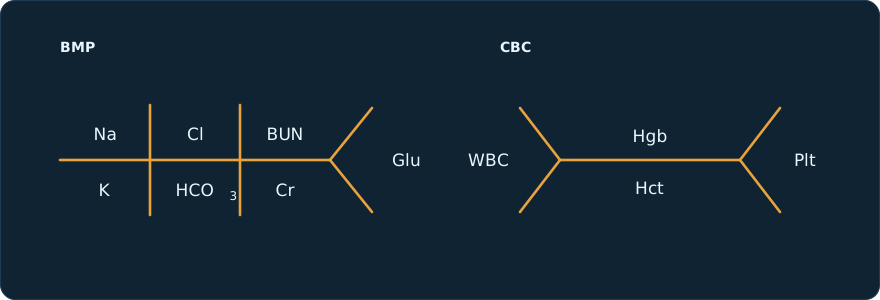
The BMP diagram reads like a sentence: the top row holds sodium, chloride, and BUN; the bottom row holds potassium, bicarbonate, and creatinine; glucose sits outside the open end. Calcium, magnesium, and phosphorus are written beside it. In the CBC diagram the white count sits on the left, hemoglobin over hematocrit in the middle, and platelets on the right. Liver and coagulation diagrams exist too, but their layouts vary between institutions, so they are usually written out as lists.
Typing labs in a note
Plain-text notes cannot draw lines, so the same order is typed in a row. A value can keep a trailing zero here, as in creatinine 1.0: the do-not-use rule on trailing zeros applies to medication doses, not lab results.
| As written | Read as |
|---|---|
| BMP: 138/4.1/102/24/18/1.0/110 | sodium 138, potassium 4.1, chloride 102, bicarbonate 24, BUN 18, creatinine 1.0, glucose 110 |
| CBC: 7.2 > 12.1/36.4 < 245 | white count 7.2, hemoglobin 12.1, hematocrit 36.4, platelets 245 |
| Cr 1.8 (b/l 1.0) | creatinine 1.8, against a baseline of 1.0 |
| K 3.1, Mg 1.6, repleted | low potassium and magnesium, both replaced |
| ABG 7.31/48/78/24 on 40% | pH 7.31, PaCO2 48, PaO2 78, bicarbonate 24, on 40% inspired oxygen |
| trop 0.04 > 0.12 > 0.31 | troponin rising across three draws; in trend lines the arrow sign reads as then |
| INR 2.6, PTT 38, plt 92 | INR 2.6, partial thromboplastin time 38 seconds, platelets 92 |
Practice typing it
Lab lines are where typing speed usually drops: digits, decimal points, slashes, and capital letters in a fixed order. The trainer's physiology and labs category and its note phrases put these formats into the stream.
Labs and physiology terms ICU notes with lab lines
Preset links open the trainer with those settings already applied; you can change them afterward.
For the abbreviations around these values, see common medical abbreviations in clinical notes; for dosing shorthand, see medication abbreviations.
Common questions
What is the difference between a BMP and a CMP?
A basic metabolic panel (BMP) has eight tests: sodium, potassium, chloride, bicarbonate (often reported as CO2), blood urea nitrogen, creatinine, glucose, and calcium. A comprehensive metabolic panel (CMP) adds six: albumin, total protein, alkaline phosphatase, ALT, AST, and total bilirubin, for 14 in all.
What is a lab fishbone diagram?
A shorthand drawing that puts each lab value in a fixed position so it can be read without labels. The BMP version puts sodium, chloride, and BUN on top, potassium, bicarbonate, and creatinine below, and glucose at the open end. The CBC version puts the white count on the left, hemoglobin over hematocrit in the middle, and platelets on the right.
What does CBC with diff mean?
A complete blood count with differential: the standard count (white cells, hemoglobin, hematocrit, platelets, and red cell indices such as MCV) plus the share and absolute number of each white cell type, such as neutrophils, lymphocytes, monocytes, eosinophils, and basophils.
How is an ABG written in a note?
Usually as four numbers separated by slashes in a fixed order: pH, PaCO2, PaO2, and bicarbonate, as in ABG 7.31/48/78/24. A venous gas (VBG) is written the same way, although its oxygen value says little about oxygenation.
Why can a lab value keep a trailing zero when a dose cannot?
The Joint Commission's do-not-use rule on trailing zeros covers medication orders and medication documentation. It allows a trailing zero where it shows real precision, such as a lab result, so creatinine 1.0 is fine, while a dose of 1.0 mg is not.
Sources
- MedlinePlus (US National Library of Medicine). Basic Metabolic Panel (BMP), Comprehensive Metabolic Panel (CMP), and Complete Blood Count (CBC).
- The Joint Commission's official do-not-use list, including the trailing-zero exception for laboratory results, as summarized in Making Health Care Safer II (AHRQ).