Arterial Line Waveform and Damping
An arterial line gives a beat-by-beat blood pressure and a waveform whose shape carries as much information as the numbers. This page labels the parts of the waveform, explains the square wave test that tells you whether to trust the reading, and lists what over- and underdamping look like, what causes them, and how they are fixed.
Last reviewed October 8, 2026. A study and documentation reference; follow your unit's line care policy.
On this page: the waveform · leveling and zeroing · the square wave test · over- and underdamping · in a note
Parts of the waveform
Each beat rises steeply as the left ventricle ejects, peaks at the systolic pressure, falls, and is interrupted by the dicrotic notch when the aortic valve closes. The rest of the downslope is diastolic runoff into the arterial tree, ending at the diastolic pressure just before the next upstroke.
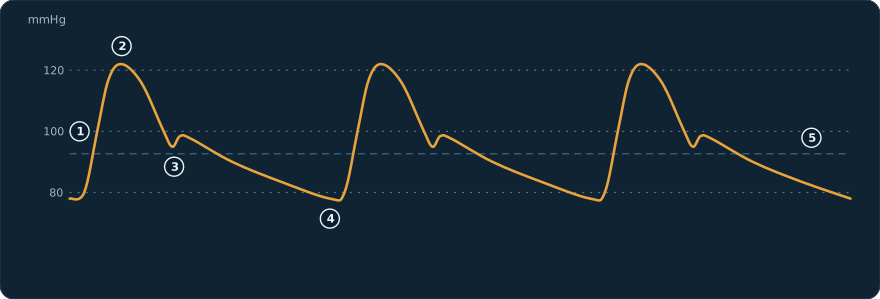
- Systolic upstroke, as the ventricle ejects.
- Systolic peak.
- Dicrotic notch, at aortic valve closure.
- End-diastolic pressure, just before the next beat.
- Mean arterial pressure.
Monitors calculate the mean arterial pressure (MAP) from the area under the curve. By hand it is approximately diastolic pressure plus one third of the pulse pressure: with 122/78, MAP is about 78 + 44 ÷ 3, or 93 mmHg.
Leveling and zeroing
The transducer is leveled to the phlebostatic axis, the fourth intercostal space in the midaxillary line, and zeroed by opening it to air. A transducer below that level reads falsely high and one above it reads falsely low, so it is releveled whenever the bed or patient moves. The flush bag is kept pressurized to 300 mmHg so the line stays open.
The square wave (fast flush) test
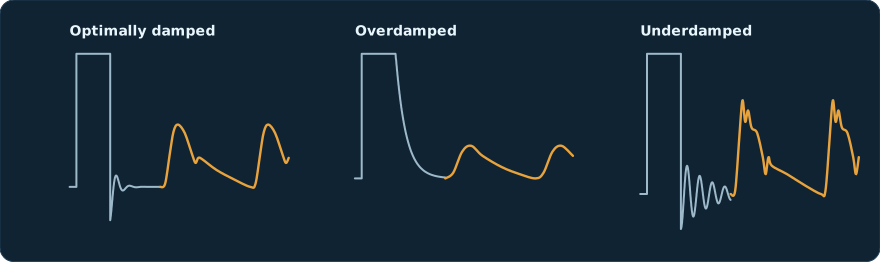
Activating the fast-flush device briefly exposes the transducer to the bag pressure, drawing a flat-topped square wave. When the flush is released the trace drops and rings before settling back into the arterial waveform, and the number of oscillations shows how well the system is damped.
Over- and underdamping
| Optimally damped | Overdamped | Underdamped | |
|---|---|---|---|
| After a fast flush | 1 to 2 oscillations | fewer than 1; slow return | more than 2, often many |
| Waveform | crisp dicrotic notch | rounded, notch lost | spiky peak, exaggerated notch |
| Systolic and diastolic | accurate | systolic falsely low, diastolic falsely high | systolic falsely high, diastolic falsely low |
| Mean pressure | accurate | close to correct | close to correct |
| Usual causes | air bubbles, clot at the catheter tip, kinked or soft tubing, loose connections, low bag pressure | long or stiff tubing, small air bubbles, tachycardia, a faulty transducer |
Because MAP survives both problems, decisions about vasopressors are usually made on the mean.
How it reads in a note
| As written | Read as |
|---|---|
| R radial 20G A-line placed, good waveform, + square wave test | right radial 20-gauge arterial line, adequate square wave test |
| art line MAP 64 on levo 0.08, cuff MAP 66 | arterial line mean pressure 64 on norepinephrine 0.08 mcg/kg/min; cuff mean 66 |
| A-line dampened, flushed, waveform restored | overdamped tracing corrected by flushing |
Practice typing it
ICU notes and lines Cardiac ICU
Preset links open the trainer with those settings already applied; you can change them afterward.
See also the central venous pressure waveform and ventilator settings and waveforms guides.
Common questions
What is the dicrotic notch?
A small dip on the downslope of the arterial waveform, made by the aortic valve closing. It marks the end of systole. A crisp notch is a sign the monitoring system is responding well; it is the first feature to disappear as a line becomes overdamped.
How do you do a square wave test?
Pull or squeeze the fast-flush device for about a second and release it. The trace jumps to a flat square wave, then rings as it returns to baseline. One to two oscillations means the system is optimally damped; fewer means overdamped, more means underdamped.
What does an overdamped arterial line do to the blood pressure?
It reads the systolic pressure falsely low and the diastolic falsely high, and the waveform looks rounded with no dicrotic notch. The mean arterial pressure stays close to correct. Air bubbles, clots, kinks, loose connections, and a pressure bag below 300 mmHg are the usual causes.
Where do you level an arterial line transducer?
At the phlebostatic axis, the fourth intercostal space in the midaxillary line, which approximates the level of the right atrium. The transducer is zeroed to atmospheric pressure at that level, and releveled whenever the patient or bed position changes.
Why does the arterial line read higher than the cuff?
Systolic pressure normally rises as the pulse travels toward the periphery, so a radial line often reads a higher systolic than a cuff or the aorta, while the mean pressure is similar. An underdamped system exaggerates the gap; compare means, not systolics.
Sources
- Saugel B, Kouz K, Meidert AS, Schulte-Uentrop L, Romagnoli S. How to measure blood pressure using an arterial catheter: a systematic 5-step approach. Crit Care. 2020;24(1):172.
- Deranged Physiology. Arterial line dynamic response testing (2023).
- University of Maryland Emergency Medicine. Arterial line square-wave test (educational pearl).
Waveforms on this page are schematic drawings made for it, not patient recordings.